As far as dealing with audio is concerned, Bluetooth is fast becoming the go-to option especially for smartphone users considering the increased number of Bluetooth audio devices being shipped. In 2019 alone, about a billion Bluetooth audio devices were shipped which in part can be attributed to the elimination of the audio jack on some of these smartphones and increasing popularity of wireless earbuds like AIrpods.
A big part of Bluetooth audio technology is the codec which is used to decode the audio format and encode it for transmission to your Bluetooth audio device. There are different types of Bluetooth audio codecs which varies in parameters such as bitrate, sample rate, bit depth, latency and energy efficiency. All of these factors in what decides how your Bluetooth audio experience will be and here is what they actually mean just in case you were wondering
Bitrate : This is the number of bits that are conveyed per second and it is measured in kilobits per second (kbps) or megabits per second (Mbps). Basically, it is the rate at which the audio data (in bits) is conveyed per seconds.
Sample rate : Otherwise known as sampling frequency is how many times in a second a sound is sampled. Each sample is a data point and the more frequency of samples the better and this parameter is measured in kilohertz (kHz). For example, standard CD audio has a sample rate of 44.1kHz which means each second of the audio on the CD has 44, 100 samples. For better audio, it is sampled at least twice the limit of human hearing which is 20kHz, even if improvement in audio quality is hard to be perceived beyond 44.1kHz. Although high-resolution audio goes up to 96kHz, the more the sample rate the larger the file size.
Bit depth : This the number of bits (of data) that is present in each sample and it dictates the audio file’s resolution. For CDs, the bit depth is 16-bits although high-resolution audio has 24-bits and it increases file size exponentially.
Latency : This is the period of delay usually between the time the audio originates to when the sound outputs.
In reality, Bluetooth bandwidth has a limited amount of data it can carry, which is where codecs come in to provide a balance of audio quality, less noise and minimal latency. It decodes digital audio which has undergone compression (encoding) and encodes it in a format that is transmitted via a Bluetooth signal.
There is one other thing that will be mentioned often throughout the course of this article which is psychoacoustic and it has to do with the science of sound perceptible to the human ear. The essence of this is to find out what to take out while compressing that would not reflect or least reflect on the audio quality.
SBC
Sub-band codec is the basic codec Bluetooth audio devices have as it is compulsory for every device with the A2DP standard It is ubiquitous so there is no issue of incompatibility between devices and in the case of codec mismatch SBC is the default codec that will be reverted to.

SBC
However, the psychoacoustic model here is elementary and does not provide room for the best audio quality. It supports a bit rate of up to 1500kbps in theory but it is limited to a max of 328kbps in Bluetooth devices by manufacturers for optimal functionality. For sample rate, SBC has support for up to 48kHz and offers acceptable audio quality.
aptX, aptX HD, aptX LL and aptX Adaptive
Moving on to Qualcomm’s codecs which you will predominantly find in android devices and happens to be a better option than SBC due to its better audio quality as well as stable connection.
The aptX codec is able to provide faster audio data transfer which helps limit data loss. Although it still uses lossy compression, it is able to deliver 48kHz sampling rate LCPM audio with a bit depth of 16-bits at a bitrate of 352kbps.
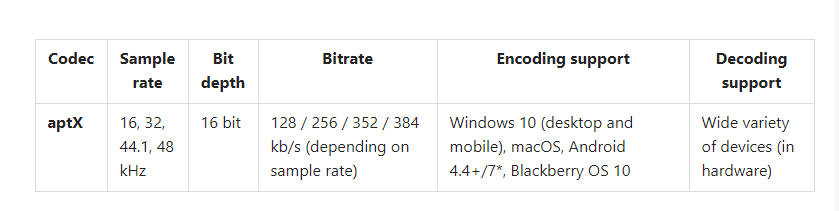
aptX
Also, there is aptX HD also from Qualcomm with an even richer bit depth of 24-bits of LCPM audio data with the same sampling rate as aptX but with a max bitrate of 576kbps. This is found in more high-end Bluetooth audio devices and smartphones.
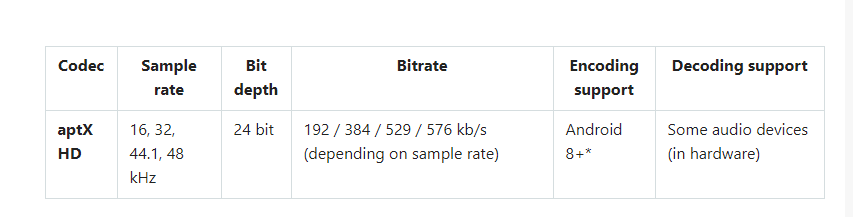
aptX HD
The aptX LL (LL for low latency) is more like an aptX codec with a lower buffer setting allowing it to achieve latency of as little as 40ms with makes it especially handy in gaming and movies.
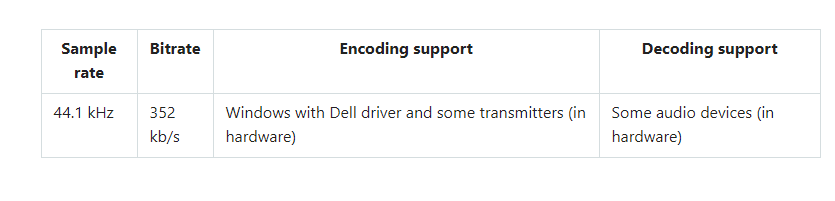
aptX LL
Moving on to the more recent aptX Adaptive which employs the low latency feature of aptX LL and audio quality of aptX HD. It supports bitrate from 279kbps to 420kbps with 16-bits/44.1kHz and 24-bits/48kHz Hi-res audio. Although not quite as fast as aptX LL it can achieve latency of as low as 50ms. It is said to replace aptX LL when it is fully adopted.
SEE: Audio formats MP3, AAC, WAV and FlAC explained
LDAC
This is Sony’s proprietary codec which was later included in the Android open source project (AOSP) and is now available in Android Oreo and higher. The key feature here is its variable bitrate that can go up to 990kbps with support for sampling rates up to 96kHz. On the other hand, there is the question of how much is perceptible to the human ear which begs the question if the high sampling rates and the higher bit depth matter if the audio format is lossly compressed?
According to soundguys.com, at high bitrates of 660kHz and 990kHz, the audio quality is compromised above 20kHz. However, at these bitrates for a 44.1kHz/16-bits LCPM audio, it has a slightly better signal to noise ration than aptX HD. Also, performance varies from one device to the other based on the preset standard from the manufacturers and you would have to dig deep in developer settings to tweak it if you want to.
LDHC
A product of collaboration between Hi-res Wireless Audio (HWA) union and Savitech and it stand for low latency and high definition audio codec. LDHC is one of the only two codecs with the Hi-Res Audio Wireless certificate alongside LDAC. Relatively new, the codec is supported by Android 10 as part of the AOSP and supports bitrates of up to 900kbps and a bit depth of 24-bit.
Furthermore, it is capable of handling a sampling rate of up to 96kHz and was first featured on the Huawei Mate 10 smartphone which gives you an idea that you might only see this on premium devices.
On the other hand, there is the LLAC (Low Latency Audio Codec) which can sometimes be referred to as LHDC LL because it is basically a version of LHDC with lower latency. That being said, it also offers up to 24-bits bit depth with the bitrate and sampling rate capped at 600kbps and 48kHz respectively. The catch here is that it offers as low as 30ms latency which makes it well suited for gaming and was first featured on the Huawei P30 smartphone.
AAC
AAC is one of the most popular codec after MP3 and employs a complex lossy compression method and is the most common audio format on the internet. No license is required for streaming or distributing content in AAC format but developers and manufacturers do have to pay a license fee. It is the standard audio codec for YouTube and the default audio codec for Apple devices.
In order to preserve audio quality, AAC employs a sophisticated psychoacoustic approach to lossy compression intending to minimize reduction in perceptible audio quality. For this reason, it requires more computing power which makes more power consuming than others.
Despite this, how each manufacture implements the codec differs greatly and on this note its performance varies depending on the device. Apple devices has shown to have the better AAC codec performance in comparison to Android devices.. Most devices have max bitrate of 320kbps or 256kbps for AAC, however, iOS devices mainly limits transfer rate to 250kbps.
Low Complexity communication Codec (Bluetooth LE Audio LC3 codec)
Unveiled in the CES 2020 event, the new codec is poised to replace the SBC standard as the default codec for Bluetooth devices with A2DP. It offers support for folks with hearing difficulty using its multistream feature to offer a better experience.
Its Bluetooth audio sharing feature also allows you to share your audio with others, so you can listen to a song on one ear while your friend listens to another thing on the other ear. It is not quite on devices yet and information is still rolling out concerning this new tech.
More: Do Bluetooth headphones (and speakers) reduce sound quality?
Conclusion
Considering not only technical specifications but how it translates to perceivable improvement in audio quality by the human ear. In addition, both the device (source) and the Bluetooth headset or speaker must support a particular codec for it to work. In that regard, we must put into account how available a particular codec is.
That being said, aptX HD still proves to be the best option for Android while for iOS AAC still remains the go-to option. For bare minimum latency, aptX is still the best option considering it is more supported by devices.
Odunayo Ezekiel is a consumer tech writer based in Nigeria with deep experience in the country’s fast-evolving tech ecosystem. From smartphones and apps to fintech and local startups, he brings sharp insight and a user-first perspective to every story. At Dignited.com, Odunayo covers the trends, tools, and innovations shaping how Nigerians—and Africans at large—experience technology.
Type your email…
Talkio Mobile , Uganda’s newest telecommunications service provider, is excited to announce a groundbreaking partnership with Banana Life Investments, a leading chain of mobile phone and retail shops. This strategic alliance aims to bring Talkio’s innovative telecom services closer to Ugandans.
This collaboration will leverage Banana Life Investments’ extensive retail network of 26 stores strategically located across Uganda in major malls, towns, and cities to provide customers with unparalleled convenience. Through this partnership, Talkio Mobile will offer its full suite of services, including SIM cards, airtime, and exclusive product offerings at any Banana Life Investment location.
This partnership is more than a business initiative—it’s a shared commitment to transforming lives. By integrating Talkio Mobile’s forward-thinking services & nationwide reach with Banana Life Investments’ retail footprint, the two brands are setting a new standard for customer convenience and inclusivity.
READ ALSO: 5 Things You Need to Know About Talkio Mobile: New Telecom Company in Uganda
“This partnership aligns perfectly with our mission of connecting Ugandans to innovative and transformative telecom solutions,” said Vianne Allan Ahura, CEO of Talkio Mobile. “By leveraging Banana Life Investments’ trusted presence and nationwide footprint, we are not only expanding our agent network but also bringing our services closer to the communities we serve. This collaboration ensures that our online customers can now enjoy a seamless offline experience right at their doorstep. Together, we are empowering Ugandans with the tools they need to stay connected, grow their businesses, and unlock new opportunities.”
Solomon Ssemuyaba, the assistant general manager at Banana Life Investments, echoed this sentiment: “We are proud to join hands with Talkio Mobile to deliver innovative, customer-centric solutions. This partnership represents our shared vision of fostering a connected future for Uganda. Together, we are redefining what convenience and accessibility mean for our customers.”
The partnership goes beyond retail distribution, introducing joint initiatives aimed at value addition and personalized service. Customers can expect seamless access to:
- SIM Card Sales : Available at all Banana Life Investments locations.
- Talkio phone number bookings : Book your preferred Talkio number at any Banana Life Investments location.
- Airtime Services : Recharge easily through in-store purchases.
- Customer Support : Friendly and knowledgeable staff trained to assist with Talkio Mobile products and services.
Additionally, the two companies plan to launch promotional campaigns and expand services to even more locations, ensuring no Ugandan is left behind in the digital transformation.
Solomon Obwot is a tech writer based in Kampala, Uganda, with extensive experience in the local tech startup ecosystem. He covers the latest news and analysis on consumer tech, writes in-depth smartphone reviews, and conducts insightful interviews with industry experts. Solomon is also a passionate podcaster, sharing his knowledge and engaging in discussions about Africa’s rapidly growing tech landscape. Send emails to [email protected]
Type your email…
The Mobile World Congress (MWC) Barcelona , the world’s largest exhibition for the mobile industry, has just concluded. This annual event gathers leading technology brands to unveil groundbreaking mobile, AI, and digital solutions innovations. At MWC 2025, TECNO showcased a range of AI-driven products, reinforcing its commitment to cutting-edge technology.
The key launches included:
- CAMON 40 Series – AI-powered smartphones with One-Tap FlashSnap and advanced mobile imaging features.
- MEGABOOK S14 – The world’s lightest 14-inch OLED laptop, featuring AI-enhanced multitasking and Snapdragon® X Elite.
- MEGABOOK T14 Air & K15S – Lightweight ultrabooks with AI capabilities and extended battery life.
- TECNO AI Glasses Series – Smart eyewear integrating AI imaging, translation, and AR display.
Jan Stryjak, Associate Director at Counterpoint Research, shared, “In the past year, we have observed significant advancements in the field of AI. AI will continue to drive transformative changes in our daily lives. In this critical period for the economic development of emerging markets, TECNO’s AI technologies are unlocking potential for diverse needs.”
“The application of AI technologies is crucial and urgent in emerging markets. We’re committed to bridging the digital gap between emerging and mature markets,” said TECNO CMO, Laury Bai. “TECNO is taking a practical approach to make AI more accessible, ensuring users in emerging markets can access AI and cutting-edge technologies.”
Laury Bai, TECNO CMO
Driven by its commitment, TECNO has forged a robust partnership with MediaTek, establishing a joint AI laboratory dedicated to accelerating advancements in AI. At the event, James Chen, Vice President of Product and Technology Marketing at MediaTek, emphasized, “The synergistic R&D efforts between TECNO and MediaTek are set to democratize AI technology. Our collaboration powers a seamless, interconnected AI experience, bringing users a future of truly connected intelligence.”
James Chen, Vice President, Product and Technology Marketing at MediaTek
CAMON 40 Series Powered by AI One-Tap FlashSnap Revolutionizes Smartphone Snapshot Photography
TECNO’s Global Product Launch Officer, Olivier Mas, officially unveiled TECNO’s next-generation AI-driven products. Attendees at TECNO’s launch event witnessed the highly anticipated debut of TECNO’s new CAMON 40 Series, a device that embodies TECNO’s legacy of excellence in mobile imaging. Featuring One-Tap FlashSnap Mode and TECNO AI, the series sets a new benchmark in smartphone photography, delivering exceptional snapshot capabilities and AI-enhanced user experiences.
Olivier Mas, TECNO Global Product Launch Officer
The CAMON 40 Series exemplifies a commitment to innovation that transcends hardware and software, extending into strategic partnerships that deliver cutting-edge AI solutions to emerging markets. Matt Waldbusser, Managing Director of Global Solutions and Consumer AI at Google Cloud, remarked, “Our collaboration with TECNO on the CAMON 40 Series is a standout example. Leveraging Google Cloud’s capabilities, we’ve introduced groundbreaking features such as Ask Ella, AI Image Generator, AI Writing, and AI Translate. I am particularly impressed by the industry-leading and competitive edge of some of these innovations. For instance, TECNO’s AI supports text translation in 136 languages, voice translation in 44 languages, and photo translation in 51 languages. We are excited to further strengthen our partnership with TECNO, unlocking limitless potential to bring advanced yet practical AI capabilities to emerging markets in a convenient and secure manner.”
Matt Waldbusser, Managing Director of Global Solutions and Consumer AI at Google Cloud
The CAMON 40 Series’ innovative One-Tap FlashSnap leverages AI to enhance imaging capabilities, revolutionizing mobile photography. AI optimizes camera startup and continuous shooting for instant captures, while AI-powered multi-frame processing intelligently reduces noise and enhances details, delivering sharper, more refined images. Additionally, the BestMoment algorithm analyzes motion patterns, automatically selecting the optimal frames for precise, high-quality shots in dynamic scenarios, ensuring users an unparalleled mobile imaging experience.
TECNO CAMON 40 Demonstrates the Cutting-Edge FlashSnap Capability
To delve deeper into the imaging prowess of the CAMON 40 Series, TECNO invited Frédéric Guichard, CEO of DXOMARK, to share the image performance of CAMON 40 Pro. Frédéric highlighted, “The CAMON 40 Pro 5G has demonstrated exceptional imaging and performance capabilities in our rigorous evaluations. We’ve been particularly impressed with photo performance being the best for devices under 600$, and the 1st eligible device to our Smart Choice Label.”
Onsite photo of Frédéric Guichard, CEO of DXOMARK
Beyond its advanced rapid-capture functionality, the integration of TECNO AI further enhances the device’s capabilities. Intelligent imaging, a 360° AI Call Assistant, and productivity tools elevate creativity and efficiency. Powered by MediaTek’s latest chipsets, the series ensures smooth performance, fast processing, and extended battery life. With a sleek, durable, and water-resistant design, it seamlessly blends style with practicality for modern users.
MEGABOOK S14, the World’s Lightest 14-inch OLED Laptop, Inspires Creators and Game Lovers
The MEGABOOK S14 is TECNO’s first OLED laptop and the industry’s lightest 14-inch OLED laptop, featuring a 2.8K OLED display and incredibly weighing only 899g (31.7oz). The laptop is equipped with the outstanding power of the Snapdragon® X Elite compute platform, the flagship chipset for AI PCs from Qualcomm Technologies, and integrates TECNO’s world’s first self-developed edge-side large-scale AI model, to achieve AI-enhanced multitasking.
World’s Lightest 14-inch Laptop MEGABOOK S14
Specifically designed for next-gen AI productivity, TECNO AI enhances the Ella AI Assistant, AI-powered PPT generation, AI-driven image search, smart albums, and offline meeting transcription with multilingual support. The External Graphics Dock, equipped with a powerful NVIDIA graphic card, delivers scalable, high-performance capabilities for design, gaming, and content creation. The laptop’s 2.8K OLED display with a 120Hz refresh rate ensures exceptional visuals, while DTS:X Ultra dual 2W speakers, Wi-Fi 6E, fingerprint login, and PC Manager optimize connectivity and user experience.
TECNO’s strategic partnership with Qualcomm Technologies was a highlight of the TECNO AI Ecosystem Product Launch event, demonstrating a shared vision for the future of AI PCs. Kedar Kondap, SVP & GM of Compute and Gaming at Qualcomm, took the stage to discuss the integration of Qualcomm’s cutting-edge PC chipset into the new MEGABOOK S14 laptop, underscoring TECNO’s commitment to delivering high-performance computing solutions.
Kedar Kondap, SVP & GM of Compute and Gaming at Qualcomm
In addition, TECNO also introduced several standout new products. The featherlight 999g (35.2oz) ultrabook MEGABOOK T14 Air, features high-speed storage and LPDDR5 memory, while the ultra-thin, all-metal MEGABOOK K15S, equipped with a powerful 70Wh battery and supported by a 65W PD GaN charger, offers a smarter and more long-lasting user experience. Both devices are empowered by TECNO AI with advanced AI capabilities such as AI Album and AI Voice Assistant, making them perfect companions for all aspects of life.
The Next Game-Changing Tech Innovation: See the World with the TECNO AI Glasses Series
TECNO’s new AI Glasses Series also took center stage with the introduction of TECNO AI Glasses Pro and TECNO AI Glasses, reimagining eyewear with cutting-edge imaging, intelligent interactions, and a sleek aesthetic. The TECNO AI Glasses feature an aviator design, while the Pro model showcases a browline style, both embodying timeless elegance and modern fashion.
TECNO AI Glasses Redefine the Way People See the Future
Equipped with a 50MP high-definition camera, the series integrates an OV50D sensor, a 100° ultra-wide-angle custom lens, and an AI ISP imaging chip, forming a mobile-grade imaging system. This system lets users capture stunning, high-resolution photos with advanced AI noise reduction and HDR capabilities. With real-time translation supporting over 100 languages, TECNO AI’s Ella empowers accurate translation even for less common languages, as well as voice control, AI-powered object recognition, and intelligent information summaries for ultimate convenience.
Additionally, the AI Glasses Pro features a MicroLED display with 7th-gen resin waveguide technology, offering a 30° field of view, over 1,500 nits of brightness AR display, and a lightweight, ultra-thin design. The AR display allows users to effortlessly enjoy features like translation display, navigation, information prompts, and teleprompting.
Equipped with a 250mAh battery, these glasses offer over 11 hours of music playback and 8 hours of mixed use with just 30 minutes of charging. An advanced ultra-linear speaker, bass enhancement, and spatial sound deliver an immersive audio experience, while Wi-Fi 6 and Bluetooth 5.4 ensure seamless connectivity.
With these innovative launches, TECNO is setting new standards in mobile imaging and AI-enhanced technology, shaping a more connected and empowered future for consumers in emerging markets. Once again, TECNO has showcased its cutting-edge innovation on the global stage at MWC. With the brand essence of “Stop at Nothing”, TECNO’s relentless pursuit of innovation is making AI-powered technology more accessible, allowing consumers to experience the future ahead of time.
Solomon Obwot is a tech writer based in Kampala, Uganda, with extensive experience in the local tech startup ecosystem. He covers the latest news and analysis on consumer tech, writes in-depth smartphone reviews, and conducts insightful interviews with industry experts. Solomon is also a passionate podcaster, sharing his knowledge and engaging in discussions about Africa’s rapidly growing tech landscape. Send emails to [email protected]
Type your email…
