Get ready Uganda: One of the most notorious surveillance companies in the world, Hacking Team in a conjunction with the Police are poised to pitch camp in your backyards (or haven’t they already)?
According to a WikiLeaks’ archive of over 400 GB of data leaked from the Hacking Team’s servers that were hacked a fortnight ago shocking details reveal email exchanges between different workers of the spyware manufacturer, the Uganda Police Force (UPF) and the “Office of the President.”
In total, there are 166 emails that mentioned Uganda ranging on a couple of issues such as security prospects, economic development, but the last email thread predating the periods between April and July 2015 spills what the malware-manufacturer discussed with UPF. An algorithms arms of trade involving sale of spyware (spying software).
This leak is in the public interest and I believe the damage to the protagonists is smaller. However, we’ll only realize the greater benefit if we focus on the bigger picture rather than being excited by the Juicy details.
Hacking Team, according to the email leaks, deals in the vending of sophisticated malware and surveillance software to security outfits. They have dealt with several countries all over the planet from those that have oppressive regimes such as Bahrain, Morocco, Ethiopia and Sudan to surprisingly, the U.S and Russia, countries which one would expect to have in house or home grown hacking/surveillance tools.
According to a former worker of Hacking Team, the scariest implications of these surveillance technologies are discerned and discussed in three things: evidence planters, kill switches and backdoors . He argues that presence of any one of them would imply that the systems are compromised beyond doubt. Here is a summary of what each of the elements means.
- An evidence planter can be used to implant evidence and remove traces on a victims’ device in order to fabricate evidence to be used in court.
- A kill switch gives an agent the ability to shut down a setup made for a customer.
- A backdoor is a technical modification of the software which is injected to run covertly whilst it steals data.
In a sort of knee jerk reaction, the Hacking Team was quick to report of the imminent dangers of its crafted malware landing in the wrong hands; terrorists. Even if that was the case, the malware is not a weapon of threat because its inherent value lies in secrecy, which by extension of the hack is already exposed and therefore lacking in value and threat.
And that is the same approach state agencies usually take when confronted with such dilemmas, they create quasi sensitive situations to diverge the attention of the media, even when the material facts say otherwise.
In an exclusive video interview with CCTV on 19 th April 2015, Jimmy Hagume, the Head of Cybercrime UPF articulated, on the record, that cases of looming terrorism activities on social media were minimal and if there existed any, they would be thwarted in no time. He added, “We are blessed and maybe fortunate that we have not had a trend where people have believed radicalization or ideology that is sweeping across other nations and other continents, and what I can say is that people mainly are using traditional methods, if they were told to communicate message, they would use a mobile phone, promise to send you mobile money or even walk to your home to use a friend to convince you to meet.”
True, there is a modicum of threat in rough clay, using traditional methods to gain form and there are enough measures and tools, still, to mitigate them. For example wiretapping phone calls, screening text messages all that are enabled by the Interception of Communications Act, 2010 which was championed by the former Premier of Uganda. Late last year, the process of purchasing a sophisticated phone-tapping machine at a tune of UGX 205 billion was finalized .
But here is what is shocking and calls for transparency, the surveillance software that Uganda is planning to buy or has already bought from Hacking Team is called RCS (Remote Control System) or creatively named Galileo, sometimes Da Vinci. According to a thread of back to back emails addressed to the Head of ICT UPF, Director Amos Ngabirano, the system is poised to have been launched in earnest by mid this month (July 2015). Notably, RCS targets computers and mobile devices of popular platforms which are Windows, Linux, Apple to steal and transmit data. What is debilitating is that the stolen data can be transferred without an active internet connection. In summary RCS’s capabilities include the ability to copy files from a computer’s hard disk, record skype calls, e-mails, instant messages, and passwords typed into a web browser. It can also turn on a device’s webcam and microphone to spy on the target. For whistleblowers who hide behind the secure encryption by Tor and other apps, RCS could potentially unveil the mask .
So if we go by the parameters that terrorism on social media and the internet at large is on a lower scale in Uganda, then what would be the reason for investment of colossal amounts of tax payers’ money in such surveillance systems?
Security: Of course, this comes first. With advancement in technological innovation comes increase in technological threats. Besides, defence and military budgets are classified, so definitely we’d never know what figures are justified for expense in acquisition of defence tools and assortment of weapons.
Surveillance is not new, it has existed from time immemorial. From the look of things nowadays, the arena is entirely on the cyberspace and a lot of gymnastics are being showcased. Another classic case was a research conducted by a German researcher about NSA’s nifty spying tools in 2007, their capability to sniff into a wi-fi connection 13 Km away. The research that was presented at the end of 2013 , 6 years later, highlighted a related case where spying-gone-bad had Wikileaks founder Julian Assange receive text messages from a Ugandan telecom number. As suspected, the GCHQ could simply have forgotten to reformat the device from an earlier Ugandan operation. So here we’re, it’s not only countries spying on their citizens but also heckling with each other in the cyber-espionage space.
Well, the issues of the state are issues of the state. There is no ambiguity in that, all animals are equal but in some distinct cases some animals are more equal than others.
The case of Justin Bieber, relax! Let’s build context here
The year is 2014, the first month of the year and Americans are going irate, their anger is stemming from pop star, Justin Bieber’s unbecoming characters – driving under the influence of alcohol and apparently desisting arrest – they say, that sets a misleading example to their children and youth from who he enjoys a cult like following. The responsible citizens are attuned to having their moral compasses facing north, straight upwards. They want him deported to Canada and his green card revoked too.
They took the fight online, not on social media but on the United States’ White House official website. Within 30 days, they had hit 100,000 petitions from real people, real Americans. It took up to 3 months, the number of petitions standing at 273,968, such an overwhelming number, that the White House communications department made a pronouncement on the petition, that they couldn’t deport the pop star because of several technical issues. That was a side step against the people’s will, their voice and democracy, if I must drag that in.
The point is governments world over are not as worried of the hashtags that we continue to prop up every other day on social media the way we may want to think. They’re just paranoid about the day to day information we share. Behind text messages, phone calls, bank transactions to mention but a few. Be the dragons behind the enormous data we share, if sniffed and methodically analyzed, shocking patterns may be found; from the impending terror attacks in plan, to the political sentiment among the public, income spending habits, the list is just endless. The list has a fancy title though, Big Data! Whoah!
I’d like to think that this big data is comprised of exabytes of useless cat videos, gifs and a bunch load of emotionally charged narcissistic Facebook posts. Of course we’re the new generation, some have touted us as the mobile first generation, we love technology, when we start tweeting away, we’re a borg, we’re mavericks.
People have an unassailable hope in technology, they have this hope that it’s the crystal ball they have been waiting to use to score their ways out. In today’s world, location and time constraints are close to negligible, everything is instant.
Whereas you’re more excited about advancements in technology, planning to livestream a regime change caused and effected through a #hashtag with a matte cased rectangular device in our hands, companies and security agencies then must be plussing 1000 to the heavens for more better opportunities to carve adverts that follow you home or even effecting 24-hour surveillance on you through that smartphone that is alienating you from people.
Let’s not discredit technology, the World Wide Web or even social media at large. For example it has been used to take down suppressing governments, the Arab Spring uprising in 2011 bears witness. Boy, change has happened because of technology. A lot of it.
And that’s why governments and security agencies in particular are interested in cyber-whatever; warfare, security, surveillance, name it. They are not taking any chances. The laws to curb purported abuse of the cyber space are in place although some, the tinging ones like PIPA and SOPA are being remodeled and repurposed.
The cyber security industry is worth $75 billion in 2015, and analysts forecast that it will be about $170 billion in 2020. Companies and government agencies are spending a lot of resources to insulate themselves against cyber threats which are raising rapidly. Some are stalking us. Obsessively, and it’s worrying.
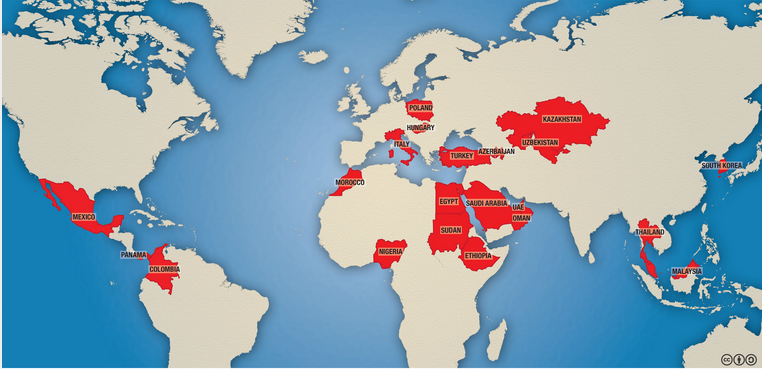
An infographic by Citizen Lab in 2014 showing the suspected clientele to Hacking Team, now that the details are in the public domain, it turns out that Uganda is not yet included on the official list as shown by the tweet below.
The on going list of clients currently renewed for 2015 are attached. And no, UG isn’t yet on the list #wikileaksUg pic.twitter.com/oMROe0O3Jo — Spartakussug (@spartakussug) July 21, 2015
Perhaps we’re to blame, we give up so much information about ourselves online. Those of us addicted to such wistful ways are like the proverbial canaries in the coal mine, the first to drop of oxygen deprivation.
Information is nothing if no one notices it, pays attention to it. When you scroll down the stream of Facebook posts or Twitter updates, Instagram photos, you may pay attention to only a dozen posts and it’s most likely other people will behave in the same way, a lot of information effervesces in the stream just like that. But secrets are different, their worth is ostensibly high especially when their nature is nefarious. Trading such is some sort of currency, a new currency independent of cold hard cash notes but rather one that is potent and consequential if ever exposed on to the public realm.
Now you know.
Image: Edited | illustration by Tim McDonagh for Matter
Daniel Mwesigwa is a curious mind at the intersection of technology, media, and politics. Passionate about emerging trends and critical thinking, he’s known for cutting through noise—calling out conspiracy theories when they don’t hold up. When he’s not writing or analyzing the digital world, Daniel enjoys listening to music and playing soccer.
Type your email…
Talkio Mobile , Uganda’s newest telecommunications service provider, is excited to announce a groundbreaking partnership with Banana Life Investments, a leading chain of mobile phone and retail shops. This strategic alliance aims to bring Talkio’s innovative telecom services closer to Ugandans.
This collaboration will leverage Banana Life Investments’ extensive retail network of 26 stores strategically located across Uganda in major malls, towns, and cities to provide customers with unparalleled convenience. Through this partnership, Talkio Mobile will offer its full suite of services, including SIM cards, airtime, and exclusive product offerings at any Banana Life Investment location.
This partnership is more than a business initiative—it’s a shared commitment to transforming lives. By integrating Talkio Mobile’s forward-thinking services & nationwide reach with Banana Life Investments’ retail footprint, the two brands are setting a new standard for customer convenience and inclusivity.
READ ALSO: 5 Things You Need to Know About Talkio Mobile: New Telecom Company in Uganda
“This partnership aligns perfectly with our mission of connecting Ugandans to innovative and transformative telecom solutions,” said Vianne Allan Ahura, CEO of Talkio Mobile. “By leveraging Banana Life Investments’ trusted presence and nationwide footprint, we are not only expanding our agent network but also bringing our services closer to the communities we serve. This collaboration ensures that our online customers can now enjoy a seamless offline experience right at their doorstep. Together, we are empowering Ugandans with the tools they need to stay connected, grow their businesses, and unlock new opportunities.”
Solomon Ssemuyaba, the assistant general manager at Banana Life Investments, echoed this sentiment: “We are proud to join hands with Talkio Mobile to deliver innovative, customer-centric solutions. This partnership represents our shared vision of fostering a connected future for Uganda. Together, we are redefining what convenience and accessibility mean for our customers.”
The partnership goes beyond retail distribution, introducing joint initiatives aimed at value addition and personalized service. Customers can expect seamless access to:
- SIM Card Sales : Available at all Banana Life Investments locations.
- Talkio phone number bookings : Book your preferred Talkio number at any Banana Life Investments location.
- Airtime Services : Recharge easily through in-store purchases.
- Customer Support : Friendly and knowledgeable staff trained to assist with Talkio Mobile products and services.
Additionally, the two companies plan to launch promotional campaigns and expand services to even more locations, ensuring no Ugandan is left behind in the digital transformation.
Solomon Obwot is a tech writer based in Kampala, Uganda, with extensive experience in the local tech startup ecosystem. He covers the latest news and analysis on consumer tech, writes in-depth smartphone reviews, and conducts insightful interviews with industry experts. Solomon is also a passionate podcaster, sharing his knowledge and engaging in discussions about Africa’s rapidly growing tech landscape. Send emails to [email protected]
Type your email…
The Mobile World Congress (MWC) Barcelona , the world’s largest exhibition for the mobile industry, has just concluded. This annual event gathers leading technology brands to unveil groundbreaking mobile, AI, and digital solutions innovations. At MWC 2025, TECNO showcased a range of AI-driven products, reinforcing its commitment to cutting-edge technology.
The key launches included:
- CAMON 40 Series – AI-powered smartphones with One-Tap FlashSnap and advanced mobile imaging features.
- MEGABOOK S14 – The world’s lightest 14-inch OLED laptop, featuring AI-enhanced multitasking and Snapdragon® X Elite.
- MEGABOOK T14 Air & K15S – Lightweight ultrabooks with AI capabilities and extended battery life.
- TECNO AI Glasses Series – Smart eyewear integrating AI imaging, translation, and AR display.
Jan Stryjak, Associate Director at Counterpoint Research, shared, “In the past year, we have observed significant advancements in the field of AI. AI will continue to drive transformative changes in our daily lives. In this critical period for the economic development of emerging markets, TECNO’s AI technologies are unlocking potential for diverse needs.”
“The application of AI technologies is crucial and urgent in emerging markets. We’re committed to bridging the digital gap between emerging and mature markets,” said TECNO CMO, Laury Bai. “TECNO is taking a practical approach to make AI more accessible, ensuring users in emerging markets can access AI and cutting-edge technologies.”
Laury Bai, TECNO CMO
Driven by its commitment, TECNO has forged a robust partnership with MediaTek, establishing a joint AI laboratory dedicated to accelerating advancements in AI. At the event, James Chen, Vice President of Product and Technology Marketing at MediaTek, emphasized, “The synergistic R&D efforts between TECNO and MediaTek are set to democratize AI technology. Our collaboration powers a seamless, interconnected AI experience, bringing users a future of truly connected intelligence.”
James Chen, Vice President, Product and Technology Marketing at MediaTek
CAMON 40 Series Powered by AI One-Tap FlashSnap Revolutionizes Smartphone Snapshot Photography
TECNO’s Global Product Launch Officer, Olivier Mas, officially unveiled TECNO’s next-generation AI-driven products. Attendees at TECNO’s launch event witnessed the highly anticipated debut of TECNO’s new CAMON 40 Series, a device that embodies TECNO’s legacy of excellence in mobile imaging. Featuring One-Tap FlashSnap Mode and TECNO AI, the series sets a new benchmark in smartphone photography, delivering exceptional snapshot capabilities and AI-enhanced user experiences.
Olivier Mas, TECNO Global Product Launch Officer
The CAMON 40 Series exemplifies a commitment to innovation that transcends hardware and software, extending into strategic partnerships that deliver cutting-edge AI solutions to emerging markets. Matt Waldbusser, Managing Director of Global Solutions and Consumer AI at Google Cloud, remarked, “Our collaboration with TECNO on the CAMON 40 Series is a standout example. Leveraging Google Cloud’s capabilities, we’ve introduced groundbreaking features such as Ask Ella, AI Image Generator, AI Writing, and AI Translate. I am particularly impressed by the industry-leading and competitive edge of some of these innovations. For instance, TECNO’s AI supports text translation in 136 languages, voice translation in 44 languages, and photo translation in 51 languages. We are excited to further strengthen our partnership with TECNO, unlocking limitless potential to bring advanced yet practical AI capabilities to emerging markets in a convenient and secure manner.”
Matt Waldbusser, Managing Director of Global Solutions and Consumer AI at Google Cloud
The CAMON 40 Series’ innovative One-Tap FlashSnap leverages AI to enhance imaging capabilities, revolutionizing mobile photography. AI optimizes camera startup and continuous shooting for instant captures, while AI-powered multi-frame processing intelligently reduces noise and enhances details, delivering sharper, more refined images. Additionally, the BestMoment algorithm analyzes motion patterns, automatically selecting the optimal frames for precise, high-quality shots in dynamic scenarios, ensuring users an unparalleled mobile imaging experience.
TECNO CAMON 40 Demonstrates the Cutting-Edge FlashSnap Capability
To delve deeper into the imaging prowess of the CAMON 40 Series, TECNO invited Frédéric Guichard, CEO of DXOMARK, to share the image performance of CAMON 40 Pro. Frédéric highlighted, “The CAMON 40 Pro 5G has demonstrated exceptional imaging and performance capabilities in our rigorous evaluations. We’ve been particularly impressed with photo performance being the best for devices under 600$, and the 1st eligible device to our Smart Choice Label.”
Onsite photo of Frédéric Guichard, CEO of DXOMARK
Beyond its advanced rapid-capture functionality, the integration of TECNO AI further enhances the device’s capabilities. Intelligent imaging, a 360° AI Call Assistant, and productivity tools elevate creativity and efficiency. Powered by MediaTek’s latest chipsets, the series ensures smooth performance, fast processing, and extended battery life. With a sleek, durable, and water-resistant design, it seamlessly blends style with practicality for modern users.
MEGABOOK S14, the World’s Lightest 14-inch OLED Laptop, Inspires Creators and Game Lovers
The MEGABOOK S14 is TECNO’s first OLED laptop and the industry’s lightest 14-inch OLED laptop, featuring a 2.8K OLED display and incredibly weighing only 899g (31.7oz). The laptop is equipped with the outstanding power of the Snapdragon® X Elite compute platform, the flagship chipset for AI PCs from Qualcomm Technologies, and integrates TECNO’s world’s first self-developed edge-side large-scale AI model, to achieve AI-enhanced multitasking.
World’s Lightest 14-inch Laptop MEGABOOK S14
Specifically designed for next-gen AI productivity, TECNO AI enhances the Ella AI Assistant, AI-powered PPT generation, AI-driven image search, smart albums, and offline meeting transcription with multilingual support. The External Graphics Dock, equipped with a powerful NVIDIA graphic card, delivers scalable, high-performance capabilities for design, gaming, and content creation. The laptop’s 2.8K OLED display with a 120Hz refresh rate ensures exceptional visuals, while DTS:X Ultra dual 2W speakers, Wi-Fi 6E, fingerprint login, and PC Manager optimize connectivity and user experience.
TECNO’s strategic partnership with Qualcomm Technologies was a highlight of the TECNO AI Ecosystem Product Launch event, demonstrating a shared vision for the future of AI PCs. Kedar Kondap, SVP & GM of Compute and Gaming at Qualcomm, took the stage to discuss the integration of Qualcomm’s cutting-edge PC chipset into the new MEGABOOK S14 laptop, underscoring TECNO’s commitment to delivering high-performance computing solutions.
Kedar Kondap, SVP & GM of Compute and Gaming at Qualcomm
In addition, TECNO also introduced several standout new products. The featherlight 999g (35.2oz) ultrabook MEGABOOK T14 Air, features high-speed storage and LPDDR5 memory, while the ultra-thin, all-metal MEGABOOK K15S, equipped with a powerful 70Wh battery and supported by a 65W PD GaN charger, offers a smarter and more long-lasting user experience. Both devices are empowered by TECNO AI with advanced AI capabilities such as AI Album and AI Voice Assistant, making them perfect companions for all aspects of life.
The Next Game-Changing Tech Innovation: See the World with the TECNO AI Glasses Series
TECNO’s new AI Glasses Series also took center stage with the introduction of TECNO AI Glasses Pro and TECNO AI Glasses, reimagining eyewear with cutting-edge imaging, intelligent interactions, and a sleek aesthetic. The TECNO AI Glasses feature an aviator design, while the Pro model showcases a browline style, both embodying timeless elegance and modern fashion.
TECNO AI Glasses Redefine the Way People See the Future
Equipped with a 50MP high-definition camera, the series integrates an OV50D sensor, a 100° ultra-wide-angle custom lens, and an AI ISP imaging chip, forming a mobile-grade imaging system. This system lets users capture stunning, high-resolution photos with advanced AI noise reduction and HDR capabilities. With real-time translation supporting over 100 languages, TECNO AI’s Ella empowers accurate translation even for less common languages, as well as voice control, AI-powered object recognition, and intelligent information summaries for ultimate convenience.
Additionally, the AI Glasses Pro features a MicroLED display with 7th-gen resin waveguide technology, offering a 30° field of view, over 1,500 nits of brightness AR display, and a lightweight, ultra-thin design. The AR display allows users to effortlessly enjoy features like translation display, navigation, information prompts, and teleprompting.
Equipped with a 250mAh battery, these glasses offer over 11 hours of music playback and 8 hours of mixed use with just 30 minutes of charging. An advanced ultra-linear speaker, bass enhancement, and spatial sound deliver an immersive audio experience, while Wi-Fi 6 and Bluetooth 5.4 ensure seamless connectivity.
With these innovative launches, TECNO is setting new standards in mobile imaging and AI-enhanced technology, shaping a more connected and empowered future for consumers in emerging markets. Once again, TECNO has showcased its cutting-edge innovation on the global stage at MWC. With the brand essence of “Stop at Nothing”, TECNO’s relentless pursuit of innovation is making AI-powered technology more accessible, allowing consumers to experience the future ahead of time.
Solomon Obwot is a tech writer based in Kampala, Uganda, with extensive experience in the local tech startup ecosystem. He covers the latest news and analysis on consumer tech, writes in-depth smartphone reviews, and conducts insightful interviews with industry experts. Solomon is also a passionate podcaster, sharing his knowledge and engaging in discussions about Africa’s rapidly growing tech landscape. Send emails to [email protected]
Type your email…
